31/44 Range oven cavity
Viking Range Oven Temperature Sensor
The slim bulb clipped to the oven's back wall that tells the thermostat how hot the cavity really is.
- Written by
- Hollis Yamada
- Works on
- Service technician — refrigeration and cooking
- Experience
- 21 years in the trade
- Published
Where the sensing end sits
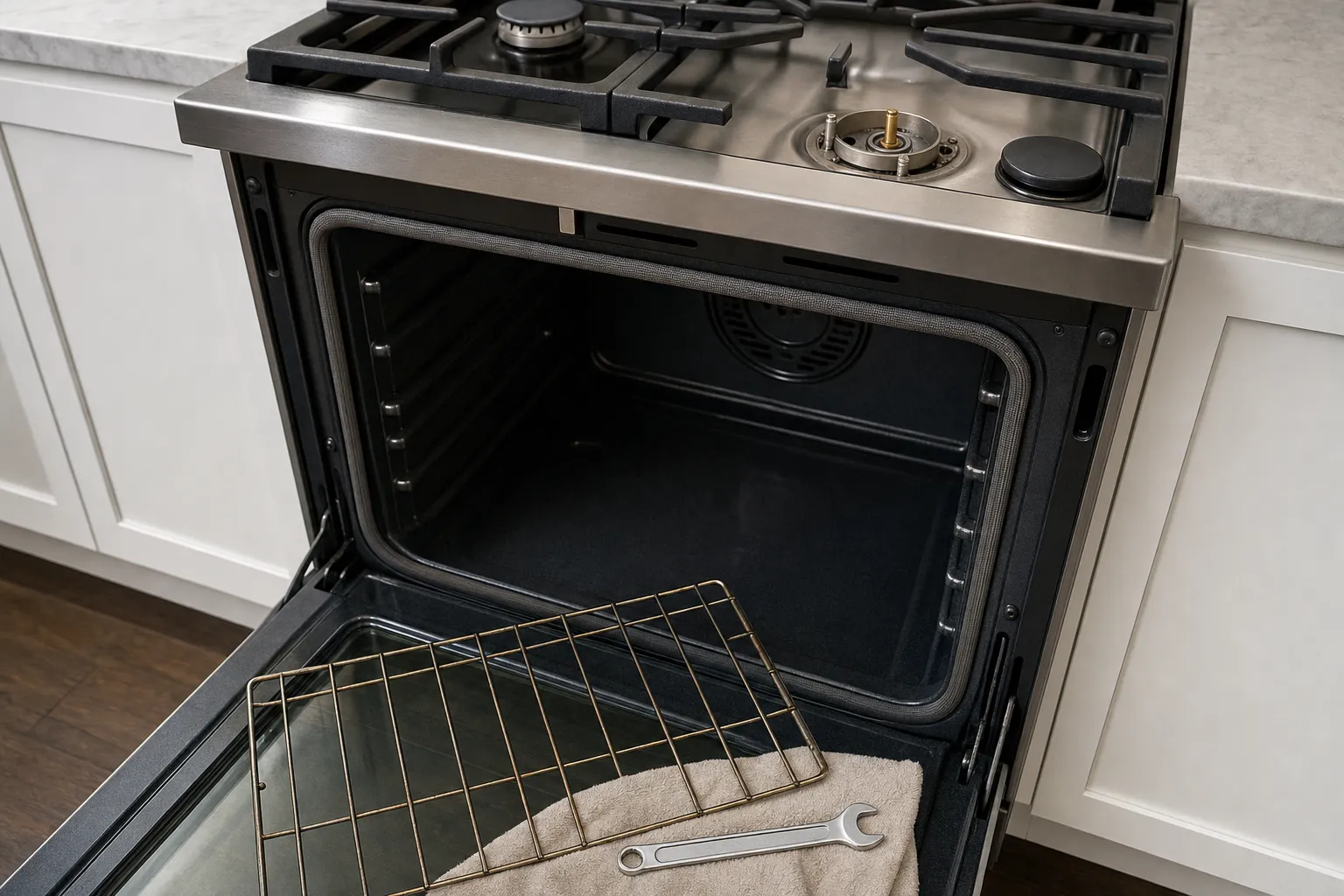
On most Viking gas ranges the oven reads its heat through a sensing bulb clipped to the inner back wall. Viking’s service manual for its freestanding gas ranges has technicians confirm the bulb is straight, clear of the liner and in its clips before judging the reading. A thin tube joins it to the knob thermostat behind the panel; they come out as one piece. Viking’s electronic built-in ovens read a resistance probe instead; if your range has a display rather than a temperature knob, a probe does this job. Nothing local wears either kind faster.
How it goes wrong
A sensing bulb seldom dies outright. It drifts, or misreads because it has moved: knocked from a clip by a pan, or pressed against the metal so it senses the wall rather than the air. The oven then runs hot or cool, or is close at one setting and well off at another. If a new igniter has gone in and it still wanders, an oven that still drifts after a new igniter weighs the next step; the test itself belongs to an oven repair visit.
Signs and thresholds
| What you notice | The line it crosses | What happens next |
|---|---|---|
| Oven thermometer and knob disagree by a wide margin | The gap is still there after a full preheat, on more than one bake | Tested over several full heating cycles before any part is named. |
| Bulb hanging out of its clips or resting on the back wall | Any bulb not held straight and clear of the metal | Reseated and retested; a kinked tube means a new thermostat assembly. |
| Close to right at moderate settings, well off at high ones | The same pattern on repeated bakes | A shifting error points at the bulb and its tube; usually replaced. |
What you can do yourself
- With the oven cold, look at the back wall: the thin bulb should sit straight in its clips. Do not bend it.
- Put an oven thermometer on the centre rack and read it after the burner has cycled a few times, not at the first beep or light.
- Stop there. Anything past this is a job for Viking Repair Issaquah — call (425) 920-9484.
When to call
Call when your thermometer and the knob stay far apart after a full preheat, when the bulb has come loose from its clips, or when bakes keep coming out over or under.
Call (425) 920-9484Asked about the oven temperature sensor
How is the sensing bulb on a Viking oven checked?
With the oven cold, the technician looks at how the bulb sits: straight in its clips, clear of the liner, and with no kink in the thin tube behind it. Then the oven is logged hot over several full bakes. Viking Repair Issaquah does both; call (425) 920-9484.
Is the sensor a separate part from the thermostat?
On most Viking gas ranges it is not: the sensing bulb, its thin tube and the thermostat body behind the knob form one assembly and come out together. Ovens run by an electronic control use a separate probe instead. Viking Repair Issaquah checks which kind yours has; call (425) 920-9484.
Why did my oven start running hot after I cleaned it?
A rack or cloth can nudge the sensing bulb out of its clips or press it against the back wall, and the oven then misjudges its own heat. Look without touching. If it has moved, Viking Repair Issaquah reseats it and retests the temperature; call (425) 920-9484.